Commercial Terrazzo Restoration and Polishing in Las Vegas
Get a binder-specific scope before anyone quotes you a grind.
Terrazzo is a composite, not a slab of natural stone. The binder holding the aggregate determines which products and methods are safe, so identification comes before any machine work.
Get Your Free Quote
Tell us what your facility needs. No obligation.
Thank You!
We'll contact you within 24 hours.
Trusted By Las Vegas Businesses








I use Busy B for commercial janitorial work including carpet cleaning and general cleaning of a 24-story building. They always give 5-star service. Would highly recommend!
We've been with Busy B since DAY ONE over 10 years ago when I opened the Millennium FANDOM BAR. From the management to the employees, everyone is just wonderful!
Their professionalism is outstanding, and the customer service is excellent.
What Terrazzo Restoration Actually Involves
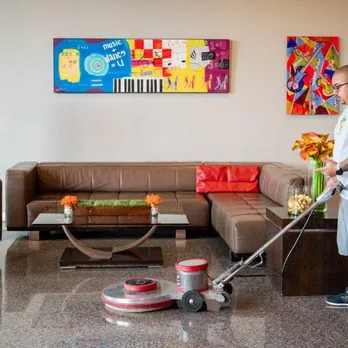
Cement or Epoxy? The Binder Decides the Method
Terrazzo is marble or similar aggregate anchored in a binder. The National Terrazzo and Mosaic Association identifies three binder systems, and they do not behave the same way.
Portland cement is the original binder and is still installed. NTMA notes that the cement binder is "the portion of this floor system that most benefits from primary protection," which makes sealing central rather than optional. Epoxy resin is the most common matrix today, and NTMA describes that binder as "fundamentally non-porous," so a sealer there protects the aggregate and the appearance rather than the binder itself. Polyacrylate modified cement sits between the two.
This is why a photo is not enough to quote from. The aggregate on top can look identical across all three systems while the correct chemistry underneath is different.
Restore or Replace?
Terrazzo is worth restoring far longer than most flooring. The aggregate is stone, the surface is renewable, and floors installed decades ago are routinely brought back rather than torn out.
Replacement enters the conversation when the problem is structural rather than cosmetic. Slab movement, substrate failure, missing or corroded divider strips, and moisture coming from below are not surface conditions, and no amount of refinishing corrects them. The walkthrough is where that line gets drawn honestly.
What Your Staff Can Safely Do Between Services
Good in-house maintenance extends the interval between restorative services. NTMA publishes its care guidance openly, and the rules are short. Dust mop daily, because NTMA is explicit that tracked-in grit "acts as an abrasive on your hard surface floor." Damp mop with a neutral pH cleaner, let it dwell several minutes, then rinse thoroughly with clean water.
The prohibitions matter just as much. NTMA names degreasers, bleach, vinegar, and ammonia as products to avoid, and warns against purely surface waxes and all purpose sealers. Vinegar is the most common violation because it is widely recommended for other surfaces and is acidic.
The full guidance is published in the NTMA Care of Terrazzo guide. Where terrazzo care belongs inside a wider janitorial program, we build it into the schedule.
Why Rinsing Matters More in Las Vegas
NTMA requires two things that work against each other in a hard-water market: rinse thoroughly, and never let the cleaning solution dry on the surface.
The Las Vegas Valley Water District water quality summary measures local total hardness at 280 parts per million, or 16 grains per gallon, with calcium at 75 ppm. Water carrying that mineral load leaves more behind when it dries, which makes the rinse-and-remove discipline harder to execute well on a large floor.
This is a procedural point rather than a claim about damage. It is the reason we plan water management and removal into terrazzo work instead of treating rinsing as an afterthought.
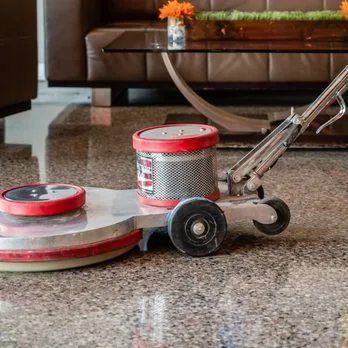
Signs Your Terrazzo Needs More Than Cleaning
A terrazzo floor can look bad for reasons that have nothing to do with the terrazzo. The useful question is whether you are looking at soil, a coating, or the surface itself.
Mopping harder will not fix any of these conditions. The NTMA remedy for a failed coating is direct: strip the old sealer and finish coats, then reseal the clean floor. That is the same coating-removal logic behind a strip and refinish on VCT, applied to a very different material.
What's Included
Identify the binder system before selecting any product or method
Assess the existing sealer, coating history, and surface condition
Separate a coating problem from damage to the terrazzo itself
Remove failed wax, acrylic, or sealer coatings where that is the issue
Clean with neutral pH chemistry per the material requirements
Rinse and remove solution thoroughly so residue is not left to dry
Polish to the agreed appearance level for the space
Apply a compatible sealer suited to the confirmed binder
Confirm the finished surface meets the slip resistance expected for the space
Provide neutral pH maintenance instructions your staff can actually follow
How It Works
Identify the Binder
Confirm whether the floor is Portland cement, polyacrylate modified cement, or epoxy resin before choosing any chemistry
Inspect the Surface
Review the existing sealer, coating buildup, etching, wear lanes, edges, and divider strip condition
Separate Coating from Damage
Establish whether the appearance problem is a failed coating, surface etching, or the terrazzo itself
Define the Scope
Choose cleaning, coating removal, polishing, sealing, or a combination based on the confirmed material and condition
Perform the Specified Work
Use neutral pH chemistry, rinse thoroughly, and keep solution from drying on the surface during the process
Seal and Hand Back
Apply the compatible sealer, confirm the reopening window, and leave written maintenance instructions
Identify the Binder
Confirm whether the floor is Portland cement, polyacrylate modified cement, or epoxy resin before choosing any chemistry
Inspect the Surface
Review the existing sealer, coating buildup, etching, wear lanes, edges, and divider strip condition
Separate Coating from Damage
Establish whether the appearance problem is a failed coating, surface etching, or the terrazzo itself
Define the Scope
Choose cleaning, coating removal, polishing, sealing, or a combination based on the confirmed material and condition
Perform the Specified Work
Use neutral pH chemistry, rinse thoroughly, and keep solution from drying on the surface during the process
Seal and Hand Back
Apply the compatible sealer, confirm the reopening window, and leave written maintenance instructions
Identify the Binder
Confirm whether the floor is Portland cement, polyacrylate modified cement, or epoxy resin before choosing any chemistry
Inspect the Surface
Review the existing sealer, coating buildup, etching, wear lanes, edges, and divider strip condition
Separate Coating from Damage
Establish whether the appearance problem is a failed coating, surface etching, or the terrazzo itself
Define the Scope
Choose cleaning, coating removal, polishing, sealing, or a combination based on the confirmed material and condition
Perform the Specified Work
Use neutral pH chemistry, rinse thoroughly, and keep solution from drying on the surface during the process
Seal and Hand Back
Apply the compatible sealer, confirm the reopening window, and leave written maintenance instructions
First-party Las Vegas job footage
The Machines That Do Terrazzo Work, on a Real Busy B Job
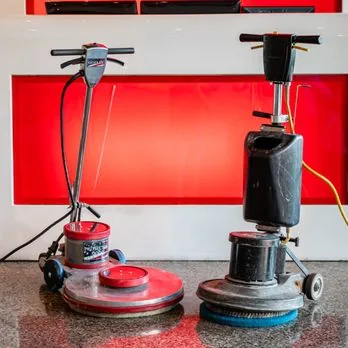
Terrazzo cleaning, coating removal, and polishing run on the same two machine classes shown here: a low-speed rotary and a compact orbital. These clips are Busy B crew footage from a Las Vegas project.
Orbital machine preparation
A compact orbital floor machine is shown working across the light plank surface during preparation.
Rotary machine work
A low-speed rotary machine provides another view of the crew working the surface.
What Affects a Terrazzo Restoration Quote?
We quote terrazzo after a walkthrough. Square footage alone does not describe the condition, the binder, or the coating history, and those are what set the labor.
Access logistics matter too. After-hours work, dry time, phased traffic routes, and the required reopening hour all change the crew plan. If the floor is part of an ongoing floor-care program, we can map out the lighter maintenance that protects the result between restorative services.
Confirmed binder system and existing sealer
Whether a failed coating has to be removed first
Current surface condition, etching, and wear depth
Edge, corner, and divider strip detail
Furniture and fixtures that must be moved
After-hours access, dry time, and the reopening hour
Whether ongoing maintenance is part of the plan
Want to understand the number before a walkthrough?
A walkthrough is what turns these factors into a reliable number, not a guess over the phone.
How We Ensure Quality & Security
Quality starts before a machine touches the floor. We confirm the binder system, document the existing sealer and coating history, and define what is a coating problem versus surface damage. Neutral pH chemistry, thorough rinsing, and a compatible sealer are part of the written scope, not decisions made after the job begins.
Quality Inspections
The final walkthrough checks gloss consistency, edges and corners, residue removal, sealer coverage, and the agreed reopening plan.
Why Las Vegas Businesses Choose Busy B
Busy B is a Las Vegas commercial cleaning and floor-care company. A client described a recent project in our own reviews as "a huge terrazzo polishing job at my facility," and that is the kind of work this page is about.
The practical advantage is coordination. Terrazzo restoration can be planned around the entrance conditions, the routine cleaning program, facility access, and whoever is responsible for reopening the space.
We also run APPA-standards audit software on our own crews, which means the maintenance that protects a restored floor is measured rather than assumed. If your building has several materials, such as natural stone, polished concrete, VCT, and carpet, each area can carry its own compatible plan.
Sometimes the right answer is a full refinish. Sometimes the floor only needs the old coating taken off and a compatible sealer put back. Identifying the binder is what tells you which.
Related Services
Pair commercial terrazzo restoration and polishing with these related services from Busy B.
Terrazzo Restoration FAQs
What is terrazzo made of?
Terrazzo is a composite, not a natural stone. Marble or similar aggregate is anchored in a binder, and the National Terrazzo and Mosaic Association identifies three binder systems: Portland cement, polyacrylate modified cement, and epoxy resin. Epoxy is the most common matrix installed today. The binder, not the aggregate, determines which products and methods are safe on the floor.
Can terrazzo be restored, or does it need replacing?
Terrazzo is worth restoring far longer than most flooring because the surface is renewable and the aggregate is stone. Replacement becomes the conversation when the problem is structural rather than cosmetic, such as slab movement, substrate failure, corroded divider strips, or moisture coming from below. Refinishing does not correct any of those.
Can you wax a terrazzo floor?
NTMA guidance is direct: do not use purely surface waxes or all purpose sealers on terrazzo. Wax and acrylic coatings are a common cause of the yellowed, cloudy appearance that gets mistaken for damaged terrazzo. In most of those cases the terrazzo underneath is sound and the coating is the problem.
What cleaner is safe for terrazzo?
NTMA specifies that only neutral pH materials should be used for scrubbing or mopping. The guide names degreasers, bleach, vinegar, ammonia, and other household chemicals as products to avoid. Vinegar is the most common mistake because it is widely recommended for other surfaces and is acidic.
Why is my terrazzo yellow?
Yellowing usually indicates an aged wax or acrylic coating rather than damaged terrazzo. Cleaning will not correct it because the discoloration sits in the coating. The NTMA remedy is to strip the old sealer and finish coats, then reseal the clean floor.
Does terrazzo need to be sealed?
NTMA specifications highly recommend a sealer applied immediately after final polishing, and water based sealers are the most commonly used today. On a Portland cement floor the sealer protects the binder, which NTMA identifies as the part of the system that most benefits from protection. On epoxy terrazzo the binder is non-porous, so the sealer serves the aggregate and the appearance. NTMA also notes that sealers should meet a slip resistance coefficient of friction rating applicable to code.
How often does terrazzo need professional service?
There is no fixed calendar. The interval depends on traffic volume, entrance soil control, the binder system, the condition of the existing sealer, and the appearance standard for the space. Consistent daily dust mopping and correct neutral pH cleaning extend it considerably.
What does terrazzo restoration cost?
We quote after a walkthrough because square footage alone does not describe the binder system, the coating history, or the surface condition, and those set the labor. The assessment is free and produces a written scope for your building.
Ready for a Cleaner Facility?
Get your free quote in minutes. No obligation.
Or Contact Us Directly: